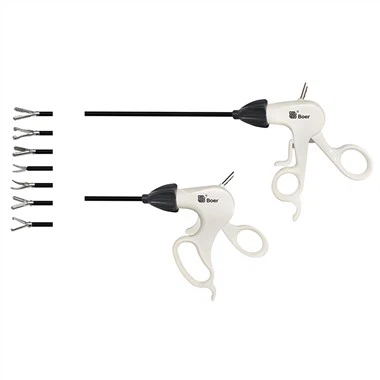
What consumables are used in gynecological laparoscopic surgery?
Jun 24, 2023
With the continuous advancement of medical technology, in recent years, laparoscopic surgery has become an important method for the treatment of intrauterine diseases and abnormal uterine bleeding, and its clinical application has become more popular.
Advances in minimally invasive technology and instruments provide more minimally invasive diagnosis and treatment methods, which is good news for doctors and patients.
Because there are many models of laparoscopic instruments and consumables, in order to better help you understand the consumables of laparoscopic instruments, the following will introduce the models of consumables related to laparoscopic surgery one by one.
What are the series of conventional laparoscopic consumables?
(1) Laparoscopic trocar series:
A laparoscopic trocar is used to create the pneumoperitoneum. Manufactured from high quality stainless steel. It consists of two parts, the outer sheath tube and the blunt inner core. The end of the outer sheath is a bevel, forming a sharp oblique blade; the inner core is slightly longer than the outer sheath, and the rear end is equipped with a spring, which can stretch beyond the needle tip of the outer sheath. When the puncture needle is pressed against the abdominal wall, the blunt tip is retracted to expose the cutting edge of the puncture needle to penetrate the tissue. Once the puncture needle penetrates the peritoneum, the blunt tip will automatically pop out to protect the internal organs of the abdominal cavity. The head end of the outer sheath is also equipped with a valve and a standard interface. When the valve is opened, air flows from the standard interface, passes through the valve, and then enters the abdominal cavity from the gap between the outer sheath and the inner core. The flow rate of the airflow and the insufflation pressure are controlled by the setting value of the automatic insufflation machine.
(2) Laparoscopic trocar and trocar sheath:
The laparoscopic trocar is a trocar that guides the trocar sheath into the abdominal cavity, and the trocar sheath is the channel through which the laparoscopic body and various operating instruments enter and exit the abdominal cavity. Laparoscopic trocars and trocar sheaths have combinations of various diameters and specifications, and are also equipped with various converters. Different cannula combinations can be selected according to different operations. Commonly used lumen diameters are 5mm, 10mm, 15mm, 20mm and so on. Laparoscopic trocars have both pyramidal and conical tips. Laparoscopic trocar sheaths are equipped with valves and ports. The former can prevent gas loss in the abdominal cavity when the mirror body and surgical instruments enter and leave the abdominal cavity, and the latter can be connected to an insufflation device or discharge smoke generated during the operation. In addition, there is also a disposable puncture cannula, which is equipped with a sheath protection device at the head of the puncture needle, and a compression spring at the tail to make the expansion and contraction free, and has an indicator mark, which can be used to judge the expansion and contraction of the sheath during surgery. It can effectively protect and avoid damage to organs by puncture needles. In addition, the airtightness inside the casing can be effectively maintained, and the use is convenient and simple. Laparoscopic trocars are more and more widely used in laparoscopic surgery because they are disposable instruments and can effectively avoid infection.
Laparoscopic electrosurgical instruments mainly include monopolar, bipolar and intelligent bipolar (Ligasure and 100-gram forceps). All are based on high-frequency electricity, and high-frequency electricity is generated by a high-frequency current generator to complete various operations such as laparoscopic coagulation, hemostasis, electric resection, and separation.
(1) Unipolar electrocoagulation equipment: one pole is outside the body, and the other pole is in the instrument. Can cauterize, dry, coagulate and cut tissue. A closed loop is formed by the high-frequency signal generator, the surgical electrode knife, the patient's tissue, the patient's electrode plate, and the high-frequency signal generator.
(2) 100-gram forceps: Using a special bipolar instrument, a specially designed modulation current is applied to the tissue. According to the intelligent feedback of the tissue, the thermal effect of the current is used to denature the collagen, so that the collagen tissue of the vessel wall is fused. , forming a transparent solidification zone to achieve closure. Its special current modulation and patented intelligent tissue feedback sensing technology can automatically stop the power output, and can safely close the uterine artery during gynecological surgery.
(3) Ligasure vascular closure system (intelligent bipolar): combined with real-time feedback technology and intelligent host technology, it can automatically identify the impedance of the clamped tissue that is only fed back immediately after each break, and instantaneously adjust the output current and voltage, combined with electrocoagulation The increased pressure between the clamps dissolves and denatures the collagen and fibrin in the blood vessel wall, and the blood vessel wall fuses to form a zona pellucida, resulting in a permanent closure of the lumen, which can resist three times the arterial systolic pressure of a normal human body. It can be used to safely close various blood vessels within 7mm, and can also be used for the treatment of ligaments and tissue bundles. It has the advantage of small heat loss (lateral heat conduction distance of 1-2mm), which can greatly shorten the operation time and reduce bleeding.